High-Level Synthesis (HLS)
Overview
HLS is originally from High-Level Synthesis Performance Prediction using GNNs: Benchmarking, Modeling, and Advancing.
After HLS front-end compilation, six node features are extracted, as summarized in the table below:
Feature |
Description |
Values |
|---|---|---|
Node type Bitwidth Opcode type Opcode Is start of path Cluster group |
General node type Bitwidth of the node Opcode categories based on LLVM Opcode of the node Whether the node is the starting node of a path Cluster number of the node |
operation nodes, blocks, ports, misc 0-256, misc binary_unary, bitwise, memory, etc. load, add, xor, icmp, etc. 0, 1, misc -1 - 256, misc |
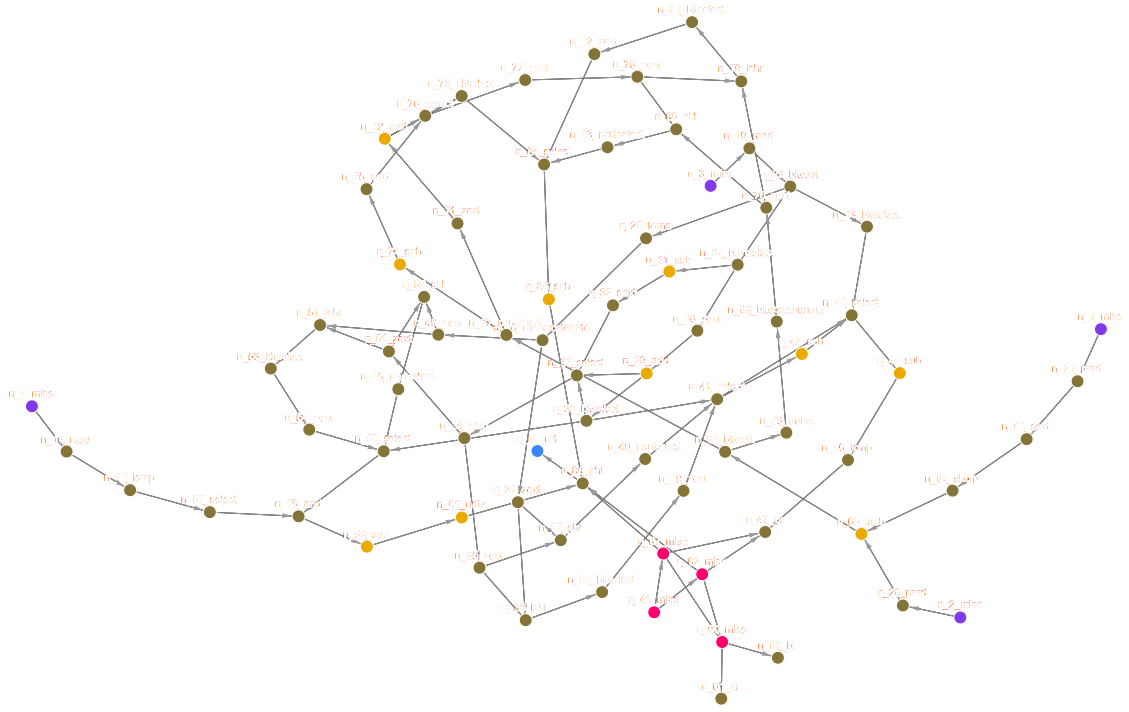
Each edge has two features, the edge type represented in integers, and a binary value indicating whether this edge is a back edge. Each graph is labeled based on its post-implementation performance metrics, which are synthesized by Vitis HLS and implemented by Vivado. Three metrics are used for regression: DSP, LUT, and CP. The first two are integer numbers indicating the number of resources used in the final implementation; the last one is CP timing in fractional number, determining the maximum working frequency of FPGA. The DFG and CDFG datasets consists of 19,120 and 18,570 C programs, respectively. The figure below shows an example C program from the CDFG dataset, with the corresponding control dataflow graph shown in the right. More information can be found in the original paper.
|

|
Interface
Runner
class HLSRunner():
    def __init__(self, config):
      # init takes a config
    def train_ray(self, tune_parameter_config):
      # function to implement training when tuning with ray
    def train(self):
      # function to implement training when evaluation
    def train_one_epoch(self, data_loader, mode, epoch_idx):
      # function that do back propogation for one epoch
    def test(self, load_statedict = True, test_num_idx = 0):
      # function for testing
    def raytune(self, tune_config, num_samples, num_cpu, num_gpu_per_trial):
      # main function to take the hyper-parameter search space in RAY
Details are in ./runner/HLS_runner.py.
DataProcessor
class HLSDataProcessor(InMemoryDataset):
    def __init__(self, config, mode):
      # init takes a config, mode takes from `tune' for tuning, `get_result' for evaluation
    def process(self):
      # key functions to implement HLS data processing
    def read_csv_graph_raw(self, raw_dir, check_repeat_edge):
      # key function to process raw data into PyG data
Details are in ./data_processor/HLS_data_processor.py.